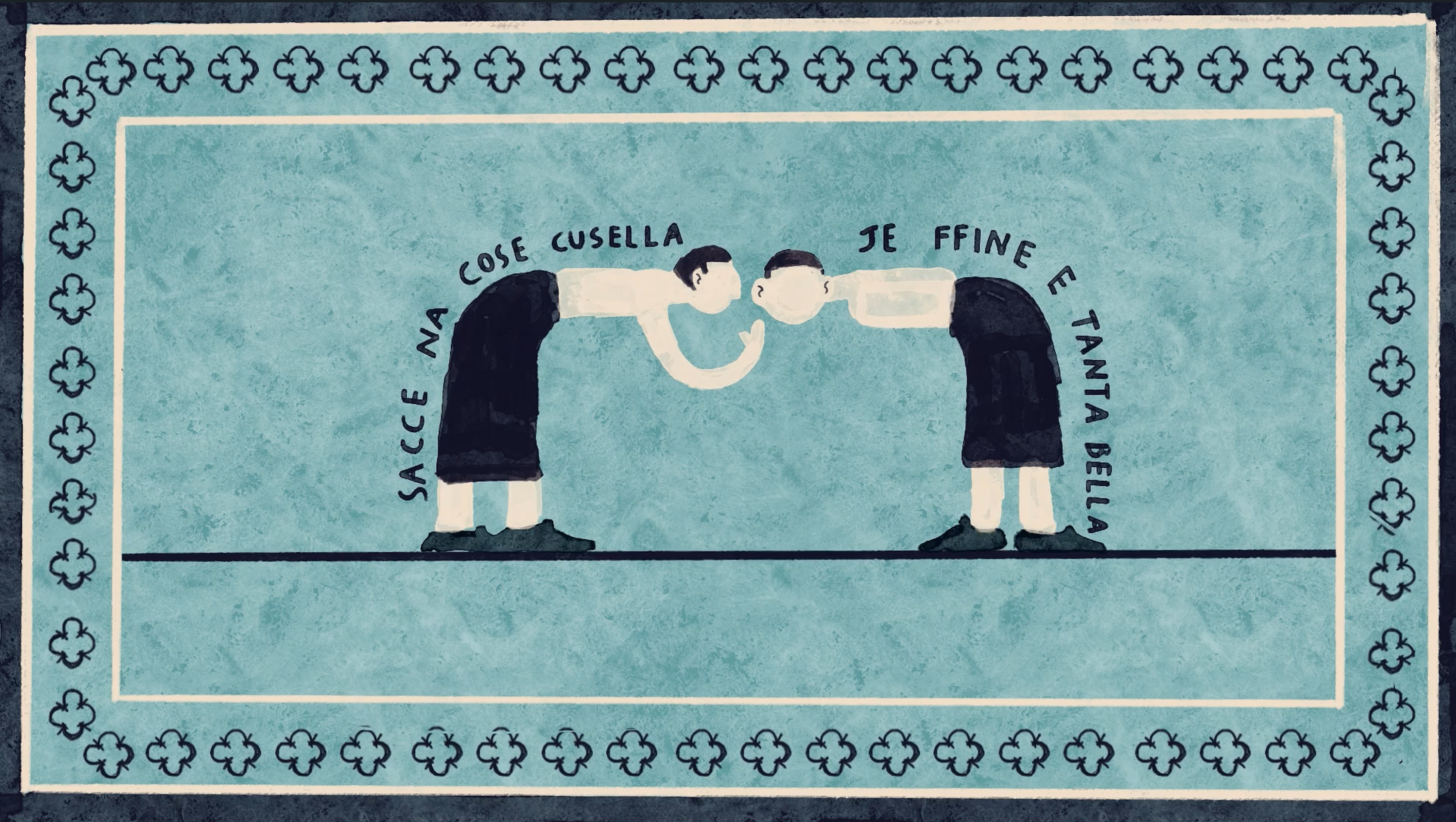
Saccë na còsa cusèlla,
iè ffinë e tanda bbèlla…MBUNDË A NU TỊMBARIÉḌḌË
C’È NU UAGNUNIÉḌḌË
CHË SÒNË U FỊŠCHËTTIÉḌḌË
E SË TÒCCHË U PËPËLLIÉḌḌËChë gghiè?

“Saccë na còsa cusèlla, iè ffinë e tanda bbèlla…”, so una cosa cusella, che è fine e molto bella: è l’introduzione di ogni indovinello agromontese, indovinelli che vanno oltre il significato apparente delle parole.
Sulla cima di un burrone (MBUNDË A NU TỊMBARIÉḌḌË), c’è un bambino (NU UAGNUNIÉḌḌË) che suona il fischietto (U FỊŠCHËTTIÉḌḌË), e si tocca il pisellino (U PËPËLLIÉḌḌË).
In un’altra versione il bambino si tocca U ČËČËLLIÉḌḌË (l’uccellino).

At the top of a ravine (MBUNDË A NU TỊMBARIÉḌḌḌË), there is a child (NU UAGNUNIÉḌḌË) playing the whistle (U FỊŠCHËTTIÉḌḌË), and touching his willy (U PËPËLLIÉḌḌḌË).
In another version, the child touches U ČËČËLLIÉḌḌḌË (the little bird).

En lo alto de un barranco (MBUNDË A NU TỊMBARIÉḌḌḌË), hay un niño (NU UAGNUNIÉḌḌË) tocando el silbato (U FỊŠCHËTTIÉḌḌË), y tocándose el pito (U PËPËLLIÉḌḌḌË).
En otra versión, el niño toca U ČËČËLLIÉḌḌË (el pajarito).

Au sommet d’un ravin (MBUNDË A NU TỊMBARIÉḌḌḌË), il y a un enfant (NU UAGNUNIÉḌḌË) qui joue du sifflet (U FỊŠCHËTTIÉḌḌË), et qui touche son zizi (U PËPËLLIÉḌḌË).
Dans une autre version, l’enfant touche U ČËČËLLIÉḌḌË (le petit oiseau).
 Il paese degli indovinelli